Turning three is an exciting stage in a child’s development. Your child is becoming more independent, communicating more clearly, asking endless questions, exploring the world with greater curiosity, and beginning to understand simple concepts about numbers, language, shapes, colours, people, and everyday life.
But this stage can also be confusing for parents.
What should a 3-year-old actually learn?
Should a 3-year-old be able to write the alphabet? Read simple words? Count to 100? Know all the colours and shapes? Complete worksheets independently?
The answer is: preschool learning is much broader than academic skills.
At around three years of age, children need opportunities to develop language, early literacy, early mathematics, thinking skills, physical coordination, creativity, social-emotional skills, independence, and curiosity.
The goal is not to make a three-year-old “study” like a school-age child.
The goal is to build the foundation for future learning.
This guide explains what a 3-year-old can learn, what parents can teach at home, which skills are appropriate at this age, and how to create a simple preschool learning routine without putting unnecessary pressure on the child.
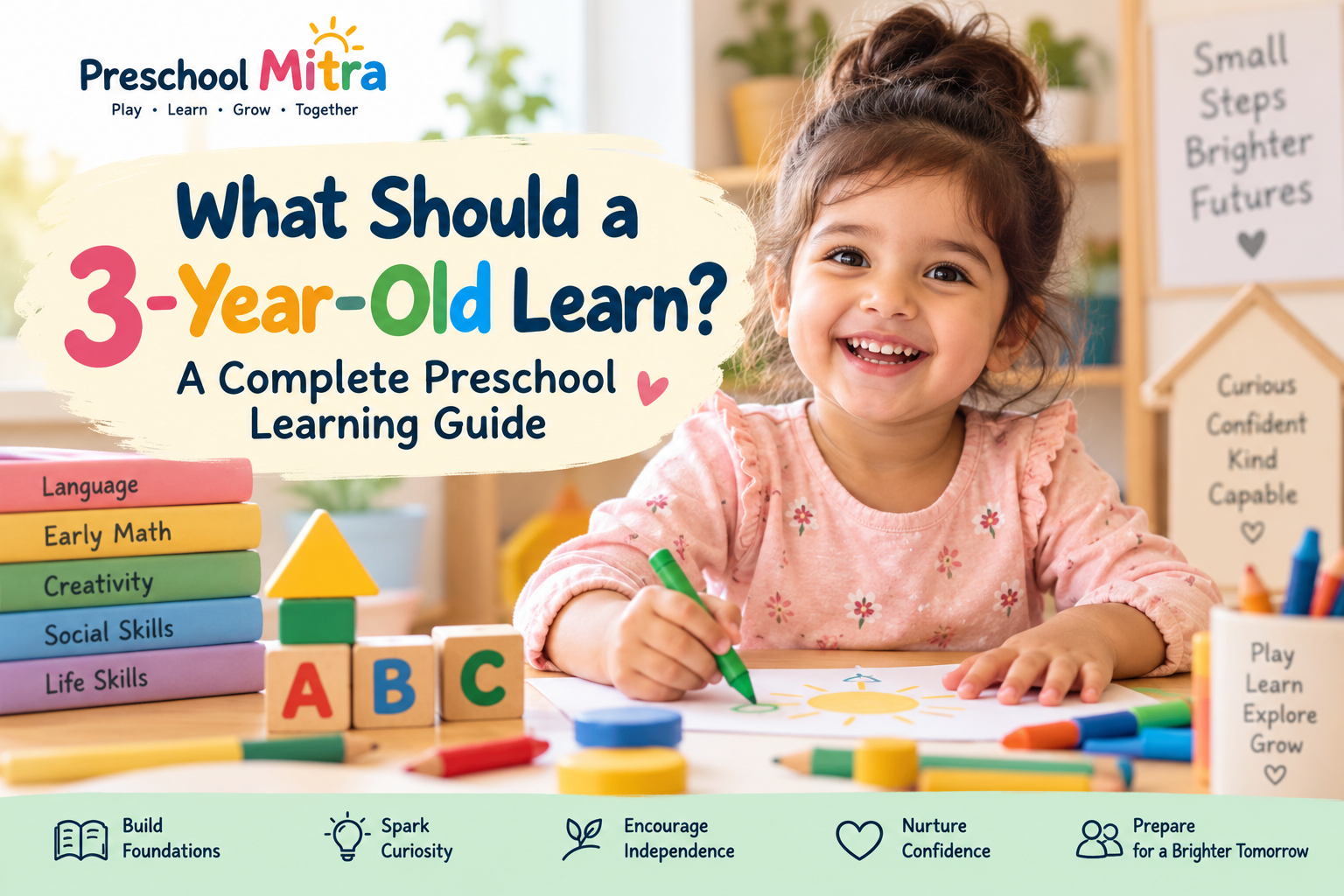
What Should a 3-Year-Old Learn?
A well-rounded preschool program for a 3-year-old should develop multiple areas rather than focusing only on ABCs and 123s.
A useful learning framework includes:
- Language and communication
- Early literacy
- Early mathematics
- Cognitive and thinking skills
- Fine motor skills
- Gross motor skills
- Social-emotional development
- Creativity and expression
- General awareness
- Independence and life skills
These areas are interconnected.
For example, when a child listens to a story, the child is not simply learning language. The child may also be developing attention, memory, imagination, sequencing, vocabulary, emotional understanding and communication skills.
That is why preschool learning should be integrated rather than divided into isolated subjects.
1. Language and Communication
Language development is one of the most important areas for a three-year-old.
At this age, children are rapidly developing vocabulary and learning how language works through conversations, stories, songs, questions and everyday experiences.
What can a 3-year-old learn?
A three-year-old can gradually develop the ability to:
- Name familiar people, objects and places
- Understand and use simple sentences
- Follow simple instructions
- Answer basic questions
- Ask questions
- Describe familiar experiences
- Talk about likes and dislikes
- Learn new vocabulary
- Listen to short stories
- Retell simple parts of a story
- Participate in conversations
- Identify familiar sounds
- Recognise and talk about everyday experiences
How can parents support language development?
You don’t need complicated teaching materials.
Talk to your child throughout the day.
Instead of simply saying:
“Put your shoes on.”
Try expanding the conversation:
“Where are your shoes? What colour are they? Can you bring them to me?”
During a walk, talk about what you see.
During meals, discuss food.
While bathing, name body parts and objects.
While playing, describe actions.
Everyday conversation is an important learning opportunity.
2. Early Literacy and Pre-Reading Skills
At three, children are beginning to build the foundations of reading and writing.
However, early literacy does not mean expecting every child to read independently.
The focus should be on readiness.
A 3-year-old can begin learning:
- To recognise their own name
- To handle books correctly
- To understand that print carries meaning
- To listen to stories
- To identify familiar pictures
- To recognise some letters gradually
- To notice beginning sounds
- To enjoy rhymes and songs
- To repeat simple rhyming words
- To talk about characters and events
- To turn pages one at a time
- To understand simple story sequences
- To make marks and drawings
- To practise basic pre-writing movements
Reading should begin with stories.
One of the simplest ways to develop early literacy is to read aloud every day.
Ask questions such as:
- “What do you see?”
- “Who is this?”
- “What do you think will happen?”
- “Where is the dog?”
- “What happened first?”
This turns story time into an interactive learning experience.
3. Early Mathematics
A three-year-old does not need advanced mathematics.
The objective is to develop number sense and mathematical thinking through real experiences.
Important early maths concepts include:
- Counting small quantities
- Recognising some numbers
- Understanding more and less
- Matching objects
- Sorting objects
- Comparing sizes
- Identifying basic shapes
- Recognising common colours
- Understanding big and small
- Understanding long and short
- Understanding full and empty
- Exploring simple patterns
- Understanding basic positional words
For example:
Instead of asking a child to repeatedly write the number 3, give them three blocks.
Ask:
“Can you give me three blocks?”
Now the child is connecting the symbol, quantity and real-world meaning.
That is more meaningful than memorising a number without understanding it.
4. Shapes, Colours and Classification
Three-year-olds naturally enjoy identifying and categorising things.
This makes shapes, colours and sorting excellent preschool learning activities.
Children can explore:
Colours
- Red
- Blue
- Yellow
- Green
- Orange
- Purple
- Black
- White
- Brown
Basic shapes
- Circle
- Square
- Triangle
- Rectangle
The objective isn’t simply memorisation.
Help children find these concepts in their environment.
Ask:
“Can you find something that is round?”
“Which toy is red?”
“Can you put all the blue blocks together?”
This develops observation, classification and early mathematical thinking.
5. Cognitive and Thinking Skills
Preschool education should help children think, not simply remember.
At three, children can participate in simple activities involving:
- Matching
- Sorting
- Finding differences
- Completing simple patterns
- Puzzles
- Memory games
- Sequencing
- Observation
- Problem solving
- Identifying relationships
- Following simple multi-step instructions
- Predicting what might happen next
For example:
Give the child several objects and ask:
“Which ones belong together?”
Or show a simple sequence:
Seed → Plant → Flower
Then ask:
“What comes next?”
These activities encourage children to observe, reason and make connections.
6. Fine Motor Skills and Pre-Writing
One area parents often overlook is fine motor development.
Before expecting a child to write letters and numbers, children need opportunities to strengthen their hands, fingers and hand-eye coordination.
Useful activities include:
- Drawing
- Scribbling
- Colouring
- Tearing paper
- Pasting
- Playing with clay
- Threading large beads
- Building with blocks
- Using tweezers
- Opening and closing containers
- Turning pages
- Finger painting
- Tracing simple lines
- Making circles
- Drawing basic shapes
Pre-writing comes before handwriting.
Children can first practise:
- Standing lines
- Sleeping lines
- Slanting lines
- Curves
- Circles
- Zig-zag movements
- Simple patterns
The goal is to develop control, coordination and confidence.
Don’t worry if a three-year-old’s writing isn’t perfect.
At this stage, the process matters more than neatness.
7. Gross Motor Development
Children also need opportunities to use their whole body.
Gross motor activities help children develop balance, coordination, strength and body awareness.
Encourage activities such as:
- Running
- Jumping
- Hopping
- Climbing
- Throwing
- Catching
- Kicking
- Dancing
- Balancing
- Walking along a line
- Outdoor play
- Simple obstacle courses
A preschool routine should not consist of sitting at a table for long periods.
Movement is part of learning.
8. Social and Emotional Learning
Academic skills are only one part of preschool education.
A three-year-old is also learning how to function in a social world.
Children can gradually learn to:
- Identify basic emotions
- Express feelings appropriately
- Wait for a turn
- Share with others
- Listen to others
- Follow simple classroom or home rules
- Participate in group activities
- Ask for help
- Show kindness
- Understand simple boundaries
- Become more independent
You can teach emotions through stories, conversations and role play.
For example:
“How do you think the little boy feels?”
“What can we do if our friend is sad?”
These simple conversations build emotional vocabulary and empathy.
9. General Awareness and Understanding the World
Three-year-olds are naturally curious about everything around them.
This curiosity can become a powerful learning tool.
Introduce concepts related to:
My Body
- Body parts
- Basic hygiene
- Healthy habits
My Family
- Family members
- Relationships
- Home
My School
- Teachers
- Friends
- Classroom routines
Animals
- Farm animals
- Domestic animals
- Wild animals
- Animal sounds
Transport
- Cars
- Buses
- Trains
- Aeroplanes
- Boats
Nature
- Plants
- Flowers
- Trees
- Sun
- Rain
- Clouds
Community
- Doctor
- Teacher
- Police officer
- Firefighter
- Shopkeeper
These topics help children understand the world around them.
10. Creativity and Imagination
A strong preschool curriculum should leave plenty of room for creativity.
At three, children should have opportunities to:
- Draw freely
- Paint
- Sing
- Dance
- Pretend-play
- Make simple crafts
- Play with clay
- Listen to stories
- Create their own stories
- Explore music
- Build with blocks
There doesn’t always need to be a “correct answer.”
If a child draws a purple tree, that’s okay.
If a child turns a cardboard box into a spaceship, that’s learning too.
Creativity develops when children are allowed to explore rather than constantly being corrected.
11. Independence and Life Skills
Preschool is also about becoming increasingly independent.
A three-year-old can gradually practise:
- Washing hands
- Eating independently
- Drinking from a cup
- Putting toys away
- Carrying their own small bag
- Wearing simple clothing
- Putting on shoes with help
- Using the toilet with appropriate support
- Keeping belongings in their place
- Helping with simple household tasks
These may not look like “academic learning”, but they are important foundations for school readiness and everyday life.
What Should a 3-Year-Old Know Academically?
Parents often ask this question.
There is no single checklist that every three-year-old must complete at exactly the same time.
Children develop at different rates.
Instead of asking:
“Can my child write everything?”
A better question is:
“Is my child gradually developing the foundations needed for future learning?”
A three-year-old may be introduced to:
Language
- Vocabulary
- Conversations
- Stories
- Rhymes
- Listening
- Simple sentence formation
Early Literacy
- Books
- Pictures
- Name recognition
- Letters
- Sounds
- Pre-reading skills
Mathematics
- Counting
- Number recognition
- Matching
- Sorting
- Shapes
- Colours
- Patterns
- Comparison
Writing Readiness
- Scribbling
- Drawing
- Lines
- Curves
- Simple patterns
- Fine motor activities
General Awareness
- Family
- Body
- Animals
- Food
- Transport
- Nature
- Community helpers
The emphasis should be on understanding and exploration rather than speed and memorisation.
A Simple Daily Learning Routine for a 3-Year-Old
You don’t need to turn your home into a classroom.
A simple routine can work extremely well.
For example:
| Time | Activity |
|---|---|
| 10–15 min | Story / conversation |
| 10–15 min | Language or phonics |
| 10–15 min | Maths / concept activity |
| 15–20 min | Art / fine motor activity |
| 20–30 min | Free play |
| 20–30 min | Outdoor / physical activity |
| Throughout the day | Everyday learning & conversation |
The exact timings do not matter as much as consistency and flexibility.
Some days your child may be highly interested in books.
Other days, your child may want to run, build, paint or explore.
That’s normal.
How Long Should a 3-Year-Old Study?
This is one of the most important questions parents should ask.
A three-year-old generally should not be expected to sit and study for long periods like an older child.
Instead, think in terms of short, meaningful learning experiences.
A 10-minute activity followed by movement or play can be far more effective than forcing a child to sit for 45 minutes.
You can use a simple principle:
Short Activity → Play → Conversation → Movement → Another Activity
The objective is not to maximise “study time.”
The objective is to maximise meaningful learning opportunities.
Should a 3-Year-Old Be Writing the Alphabet?
Not necessarily.
Some children may already enjoy tracing or writing simple letters. Others may still be developing the fine motor control required for writing.
Both can be completely normal.
Before expecting fluent handwriting, provide plenty of opportunities for:
- Scribbling
- Drawing
- Colouring
- Finger activities
- Clay play
- Puzzles
- Threading
- Tracing
- Pattern making
- Hand-eye coordination
Handwriting readiness is a process, not a race.
Should a 3-Year-Old Learn Phonics?
Early exposure to sounds can be beneficial.
However, phonics should be introduced in a playful and age-appropriate way.
For example:
“B says /b/. What starts with /b/?”
Then connect the sound to familiar objects:
B → Ball → Book → Banana
Songs, stories, picture cards and games can make early phonics enjoyable.
The objective at this stage is to build sound awareness and positive associations with language, rather than rushing children into reading independently.
What About Worksheets?
Worksheets can have a place in preschool learning, but they should not become the entire learning experience.
A child may complete a worksheet correctly without fully understanding the concept.
For example, instead of only giving a worksheet about circles:
- Find circles around the house.
- Touch and identify them.
- Sort round objects.
- Draw circles.
- Make circles with clay.
- Finally, complete a simple worksheet.
This creates a richer learning experience.
Real objects + conversation + activity + practice + observation can be much more meaningful than worksheet repetition alone.
Why Theme-Based Learning Works Well for 3-Year-Olds
Young children learn naturally through connections.
Instead of teaching colours, language, maths and general awareness as completely separate experiences, a theme can connect several learning areas.
For example, consider the theme:
“My Family”
A child can learn:
Language:
Family vocabulary and conversations.
Maths:
Counting family members.
Art:
Drawing a family picture.
General Awareness:
Understanding relationships.
Social-emotional learning:
Talking about love, caring and helping.
Pre-writing:
Drawing and tracing simple family-related pictures.
One theme can therefore create many meaningful learning opportunities.
This is the thinking behind integrated, theme-based preschool learning.
A 3-Year-Old Does Not Need to “Finish the Syllabus”
This is an important mindset shift for parents.
Preschool should not become a race to finish books.
A child may understand a concept after one activity.
Another child may need repeated experiences.
Another may understand it through play rather than worksheets.
Learning at this age is often spiral and experiential.
Children revisit concepts repeatedly in different contexts.
For example:
A child may learn the concept of “big and small” through:
- Toys
- Fruits
- Animals
- Pictures
- Sorting activities
- Stories
- Everyday conversations
Each experience strengthens understanding.
How Parents Can Make Preschool Learning More Effective
1. Follow your child’s interests
If your child loves animals, use animals to introduce counting, colours, vocabulary and stories.
2. Keep activities short
Young children learn better when activities match their attention span.
3. Use real-life experiences
Cooking, shopping, travelling, cleaning and outdoor walks can all become learning experiences.
4. Repeat without making it boring
Children need repetition.
But repetition can happen through different games and activities.
5. Ask questions
Don’t always provide the answer.
Ask:
“What do you think?”
“Why?”
“What happens next?”
“Can you find another one?”
6. Let children move
Learning doesn’t always have to happen at a table.
7. Celebrate effort
Instead of only saying:
“Correct!”
Try:
“You tried a different way.”
“You noticed that!”
“You kept trying.”
This builds confidence and a positive attitude toward learning.
What Parents Should Avoid
There is no need to rush a three-year-old into academic pressure.
Try to avoid:
- Long study sessions
- Excessive worksheets
- Comparing your child with other children
- Forcing handwriting before readiness
- Constant testing
- Correcting every mistake
- Memorisation without understanding
- Using learning as punishment
- Expecting perfect work
- Treating play as wasted time
Remember:
The goal of preschool is not to produce a small adult. It is to build a confident, curious learner.
A Simple 3-Year-Old Learning Checklist
You can use this checklist as a broad guide—not as a test.
Language & Communication
☐ Talks about familiar things
☐ Understands simple instructions
☐ Asks questions
☐ Learns new words
☐ Enjoys stories and rhymes
Early Literacy
☐ Enjoys looking at books
☐ Listens to stories
☐ Recognises familiar pictures
☐ Shows interest in letters
☐ Practises pre-writing movements
Early Maths
☐ Counts small groups of objects
☐ Recognises some numbers
☐ Matches objects
☐ Sorts objects
☐ Recognises basic shapes
☐ Identifies common colours
☐ Notices simple patterns
Physical Development
☐ Runs and jumps
☐ Throws and catches
☐ Uses crayons
☐ Builds with blocks
☐ Enjoys fine motor activities
Social-Emotional
☐ Expresses feelings
☐ Participates in simple group activities
☐ Begins to take turns
☐ Follows simple rules
☐ Asks for help when needed
Independence
☐ Helps put toys away
☐ Attempts simple self-care
☐ Participates in everyday routines
☐ Shows growing independence
Remember that this checklist is not a developmental test. Children develop at different rates, and individual differences are normal.
If you have concerns about your child’s development, discuss them with your child’s pediatrician or an appropriately qualified child-development professional.
The Best Preschool Learning System Is More Than Books
A book can introduce a concept.
But meaningful preschool learning happens when children get opportunities to see, hear, touch, talk, move, practise, play and apply that concept.
That is why a strong preschool learning system should bring together:
Books + Activities + Play + Conversation + Practice + Observation + Progress Tracking
This approach gives parents a clearer roadmap while still allowing children to learn naturally.
How Preschool Mitra Approaches Learning for Young Children
At Preschool Mitra, we believe preschool should be structured—but never unnecessarily stressful.
Our approach combines age-appropriate curriculum, thematic learning, activities, practice and guided learning so that children can experience concepts in multiple ways.
For parents who want to create a structured preschool learning experience at home, a complete Home Preschool system can provide:
- Age-appropriate curriculum books
- Homeschooling guidance for parents
- Preschool activities
- Printable worksheets
- Flashcards
- Progress tracking
- Home preschool planning
- Annual activity and celebration planning
The idea is simple:
Parents shouldn’t have to search for a different activity, worksheet, book and learning plan every single day.
A well-planned preschool system can give parents a clear direction while giving children room to learn through play and exploration.
Final Thought: At Three, Learning Should Feel Like Discovery
A three-year-old is not supposed to know everything.
This is the age to ask questions.
To touch things.
To make mistakes.
To listen to stories.
To sing.
To run.
To build.
To draw.
To count.
To explore.
To wonder.
To try again.
The most valuable outcome of preschool is not how many worksheets a child completes or how quickly they can write the alphabet.
It is whether the child is becoming a curious, confident and engaged learner.
So, when you ask:
“What should my 3-year-old learn?”
Think beyond ABCs and 123s.
Think about the skills, experiences and foundations that will help your child become ready for a lifetime of learning.
Preschool is not about rushing children toward school.
It is about preparing them to love learning.
Frequently Asked Questions
1. What should a 3-year-old know academically?
A three-year-old can be introduced to early language, literacy, numbers, counting, shapes, colours, patterns, pre-writing and general awareness. However, children develop at different rates, so there is no single academic checklist that every three-year-old must master.
2. Should a 3-year-old be able to read?
Not necessarily. At three, the focus should generally be on early literacy foundations such as listening to stories, vocabulary, communication, book awareness, rhymes, sounds and interest in letters.
3. Should a 3-year-old know the alphabet?
Children can certainly be introduced to letters at this age. However, recognising or naming every letter should not become a source of pressure.
4. How much should a 3-year-old study?
Learning sessions should generally be short and flexible. Preschool learning should be balanced with play, movement, conversation, outdoor activities, rest and everyday experiences.
5. What are the best activities for a 3-year-old?
Storytelling, pretend play, sorting, matching, counting objects, puzzles, drawing, colouring, clay activities, sensory play, outdoor games, music, movement and simple practical activities are all useful.
6. Can I teach my 3-year-old preschool at home?
Yes. Parents can create meaningful preschool learning experiences at home using a structured routine, age-appropriate curriculum, books, activities, play and everyday experiences.
7. What is the most important thing a 3-year-old should learn?
There isn’t one single skill. A strong foundation includes communication, curiosity, early literacy, mathematical thinking, physical development, social-emotional skills, independence and a positive attitude toward learning.
Ready to Make Preschool Learning at Home Easier?
You don’t need to be a trained teacher to give your child a meaningful preschool experience at home. What you need is the right roadmap, age-appropriate resources and a simple structure that helps you know what to teach, how to teach it and how to see your child’s progress.
That is exactly what Preschool Mitra’s Home Preschool System is designed to provide.
From age-appropriate curriculum books and activity resources to a Parent Guide, flashcards, printable worksheets, Progress Tracker, Home Preschool Planner and an annual activity calendar, everything is thoughtfully brought together to help parents create a structured yet joyful learning environment at home.
Because preschool learning shouldn’t be about keeping children busy with worksheets.
It should be about helping them learn, explore, express, discover and grow—one meaningful concept at a time.
Give your child a better beginning with Preschool Mitra.
Explore the Preschool Mitra Home Preschool System and start your child’s preschool journey at home with confidence.
For Details Contact Preschool Mitra : +91 7017808975