


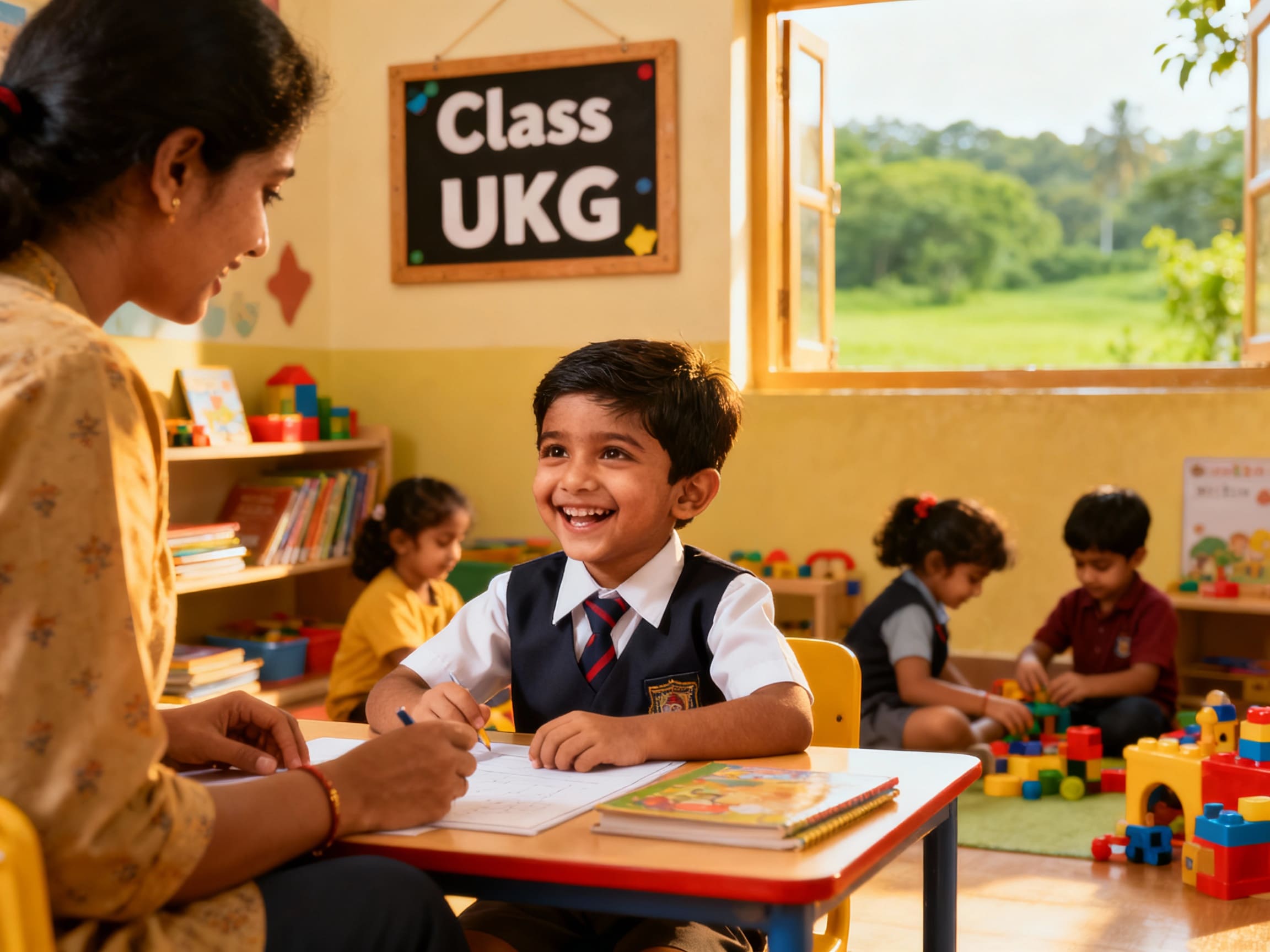
UKG (Upper Kindergarten), also called KG‑2 or Senior KG in some schools, is usually for children aged 5–6 years.
It is the final year of the Foundational Stage (3–8 years) before children enter Class 1, so the syllabus focuses on strong readiness for primary school while still keeping learning playful and joyful.
NEP 2020 and the National Curriculum Framework for the Foundational Stage (NCF‑FS) emphasise that early learning must be integrated, play‑based and developmentally appropriate, not exam‑driven.
A good UKG syllabus in India therefore builds solid foundations in language, maths, environmental awareness, motor skills, and social‑emotional growth, rather than just finishing big textbooks.
Main Goals of UKG (5–6 Years)
By the end of UKG, most children are expected to:

-
Speak clearly in full sentences, take part in conversations, and listen with attention.
-
Read simple words and short sentences with understanding, and write basic words neatly.
-
Understand and use numbers more confidently, including simple addition and subtraction with objects or pictures.
-
Show better control of their body and hands during writing, drawing, games and sports.
-
Follow classroom rules, work with peers, and manage feelings in healthy ways.
These goals are in line with learning outcomes laid out for the Foundational Stage in national documents.
Language and Literacy in UKG
Language is a major part of the UKG syllabus, covering English and often Hindi or another home/regional language.
The aim is to move from mainly oral language to early reading and writing, while keeping activities meaningful and engaging.
Key language components:
-
Listening and Speaking
-
Listening to longer stories and answering “who / what / where / why / when” questions.
-
Participating in class discussions about daily routine, pictures, themes and experiences.
-
Narrating a short event (a visit, a festival, a holiday) in simple sequence.
-
-
Vocabulary and Grammar Basics
-
Building vocabulary related to themes like seasons, community helpers, plants, animals, transport and country.
-
Using basic describing words (big, small, hot, cold, happy, sad, tall, short).
-
Simple grammar concepts in English such as “this/that”, “in/on/under”, and use of “is/are”.
-
-
Alphabet, Phonics and Reading
-
Full familiarity with capital and small letters A–Z in correct order and mixed order.
-
Phonics: identifying beginning, middle and ending sounds in simple CVC words (cat, pin, bus), blending sounds to read words.
-
Reading simple words, short sentences and very short stories with picture support.
-
-
Writing Skills
-
Writing capital and small letters clearly in four‑line or three‑line notebooks, as per school pattern.
-
Copying and then writing simple CVC words, 2–3 letter or 4–5 letter words, and short sentences.
-
Writing their own name, names of family members, and basic sight words.
-
In Hindi (or another Indian language), children are usually introduced to svar (vowels), vyanjan (consonants) and simple matras, again through rhymes, stories and picture‑supported reading and writing.
Mathematics in UKG
UKG maths takes children beyond counting into more concrete number operations and deeper understanding of quantity and patterns.
Common maths topics in UKG:
-
Numbers and Counting
-
Number recognition usually from 1–100 (varies by school/board).
-
Oral counting forwards and often backwards within smaller ranges (e.g., 30–1).
-
Writing numbers at least from 1–50 or 1–100 with correct formation.
-
-
Number Concepts and Operations
-
Understanding more/less, equal to, and comparing numbers using objects and symbols (<, >, =) in some schools.
-
Simple addition and subtraction using objects, pictures or number lines (e.g., 2+3, 5–2).
-
Concept of zero (nothing left) in concrete contexts.
-
-
Shapes, Patterns and Measurement
-
Recognising 2D shapes and sometimes introducing 3D objects (ball, box, cylinder) informally.
-
Creating and extending patterns with colours, shapes and numbers.
-
Informal measurement: comparing length (longer/shorter), height (taller/shorter), weight (heavier/lighter) and capacity (full/empty).
-
-
Time and Money (Very Basic)
-
Understanding parts of the day—morning, afternoon, evening, night.
-
Recognising simple clocks (o’clock) and understanding “yesterday–today–tomorrow” in a very basic way.
-
Recognising common Indian coins/notes through pretend play, not formal calculations.
-
Math should still rely heavily on manipulatives, games and real‑life contexts, not just worksheets.
Environmental Studies / General Awareness
UKG children are ready for deeper exploration of their surroundings and community.
Environmental Studies (EVS) or General Awareness gives them language and concepts for what they see around them.
Typical EVS topics include:
-
Myself and My Body: body parts and their functions, keeping clean and healthy.
-
Family and Neighbourhood: types of families, roles of family members, neighbours, neighbourhood places.
-
School and Community Helpers: people at school and in the community (doctor, nurse, police, firefighter, postman, shopkeeper).
-
Food: types of food (healthy vs junk), meals in a day, sources (plants/animals).
-
Animals and Birds: pet, farm, wild animals; habitats; caring for animals.
-
Plants and Trees: parts of a plant, uses of plants, importance of trees.
-
Transport and Communication: land, air, water transport, basic traffic rules, common means of communication (phone, letters).
-
Seasons and Weather: summer, winter, rainy; clothes and activities in each.
-
Our Country: national symbols, national festivals, flag, national leaders in a very basic way.
EVS should be taught through stories, picture talks, projects, walks, and hands‑on observation, not just memorisation.
Physical Development: Gross and Fine Motor
Even at 5–6 years, physical development is a core part of the syllabus and is directly linked to attention, confidence and health.
Gross motor development in UKG:
-
Running, hopping, skipping and jumping with more control.
-
Participating in simple team games and relays.
-
Practising balance and coordination on beams, lines, or low equipment.
-
Child‑friendly exercise routines, yoga and movement with music.
Fine motor development:
-
Neater drawing and colouring; controlled strokes in writing.
-
Using scissors safely for cutting along lines and shapes.
-
More complex puzzles, construction sets, lacing and bead work.
These skills support writing stamina and independence in daily life.
Social, Emotional and Value Education
UKG children are on the verge of entering formal primary school, so social and emotional readiness is essential.
Key goals include:
-
Working in pairs and small groups, sharing responsibility for tasks.
-
Managing common emotions like anger, jealousy and disappointment in healthier ways.
-
Developing empathy—understanding that others may feel differently and need support.
-
Building confidence to speak in front of the class and participate in events.
Value education emphasises:
-
Honesty, kindness, respect for elders and peers.
-
Caring for public property and the environment.
-
Basic ideas of fairness, sharing, and following rules for everyone’s safety.
Stories, circle‑time discussions, and reflective activities are effective tools here.
Creative Arts, Music and Drama
Creative expression continues to be a vital part of the UKG syllabus.
Children engage in:
-
Art and Craft: drawing scenes, making cards, festival crafts, simple origami and collage.
-
Music: more complex rhymes and songs, rhythm activities, using simple instruments in patterns.
-
Drama and Role‑Play: skits based on stories, role‑plays of community helpers, simple stage performances for events.
These activities support imagination, communication skills, and confidence on stage.
Life Skills and Independence
UKG is the time to strengthen life skills so that children are ready for the increased expectations of Class 1.
Basic life skills focus on:
-
Managing toilet needs and personal hygiene with full independence.
-
Keeping personal belongings organised—books, stationery, water bottle and lunch box.
-
Following class schedules, transitions, and rules without constant reminders.
-
Helping with small classroom jobs—handing out books, tidying corners, watering plants.
These habits build responsibility and self‑esteem.
A Balanced Daily Routine for UKG
A child‑friendly UKG timetable usually includes:
-
Arrival and free play / settling activities.
-
Circle time (greetings, calendar, weather, short discussion).
-
Language block (phonics, reading, writing) using stories and games.
-
Short break and washroom routine.
-
Math and EVS activities with manipulatives and theme‑based tasks.
-
Outdoor play and physical activities.
-
Art, craft, music or drama sessions.
-
Wrap‑up reflection, story or sharing time.
This balance helps children focus without feeling overwhelmed.
How Parents and Schools Can Support UKG Learning
Schools and teachers can:
-
Keep the UKG curriculum aligned with Foundational Stage guidelines—integrating language, math, EVS, art and play, not treating them as separate silos.
-
Use continuous and holistic assessment rather than only tests, observing children’s progress in all domains.
-
Communicate clearly with parents about realistic expectations for reading, writing and numbers in UKG.
Parents can:
-
Read books and talk with their child daily instead of relying only on extra worksheets.
-
Create a calm routine for sleep, meals and study, and avoid academic pressure or comparison.
-
Praise effort, curiosity and kindness, not just marks or speed.
When home and school work together with a clear, age‑appropriate view of the UKG syllabus, children enter Class 1 confident and happy.
How Preschool Mitra’s Thematic Curriculum and Book Sets Support UKG
For many independent preschools, designing a full UKG program that is NEP‑aligned, structured and still playful can be challenging.
This is where ready, research‑based solutions like Preschool Mitra’s Thematic Learning Curriculum and Book Sets for UKG can help.
Preschool Mitra’s approach offers:
-
Theme‑based learning where each unit (e.g., “My Country”, “Plants and Animals”, “Transport”) integrates English, Hindi, Maths, EVS, values and activities around one central idea.
-
A simple “1 Day – 1 Book – 1 Concept” structure, so each day’s reading, writing, number work, and activity are organised in one place for teachers and children.
-
Clear teacher notes on every page—subject, skill focus, and objective—aligned with Foundational Stage learning outcomes.
-
Child‑friendly UKG book sets plus teacher guides and assessment formats to track holistic progress, not just academics.
-
The option of custom‑branded books carrying the preschool’s name and logo, giving independent schools a professional, franchise‑level feel without losing their identity.
For parents, this kind of curriculum means a clear, coherent learning journey for their child in UKG.
For school owners and teachers, it means less planning stress, more consistent quality, and a smoother transition for children into primary school.
Great article! Parents often get confused about what should be included in a kg class syllabus, and this guide explains it in a simple and practical way. A well-balanced curriculum that combines literacy, numeracy, play, and social-emotional learning truly helps children prepare for Class 1.