


Achievement Card for Preschool: A Better Way to Assess Child Development Beyond Marks & Grades
Preschool Mitra | Holistic Preschool Assessment System
For years, schools and preschools have used report cards to communicate a child’s progress. But when it comes to children between 2 and 6 years of age, an important question needs to be asked:
A child may not yet be able to write a letter independently, but may be confidently communicating with classmates.
Another child may struggle with counting, but may demonstrate excellent problem-solving skills while playing.
One child may be quiet during circle time but show exceptional creativity through art.
Can marks and grades really tell the complete story of a preschool child’s development?
Another may be developing language more slowly but demonstrate excellent motor coordination and independence.
Can one grade capture all of this?
Probably not.
The early years are a period of extraordinary development. Children are simultaneously developing language, early literacy, numeracy, physical coordination, social relationships, emotional awareness, creativity, curiosity, independence and an understanding of the world around them.
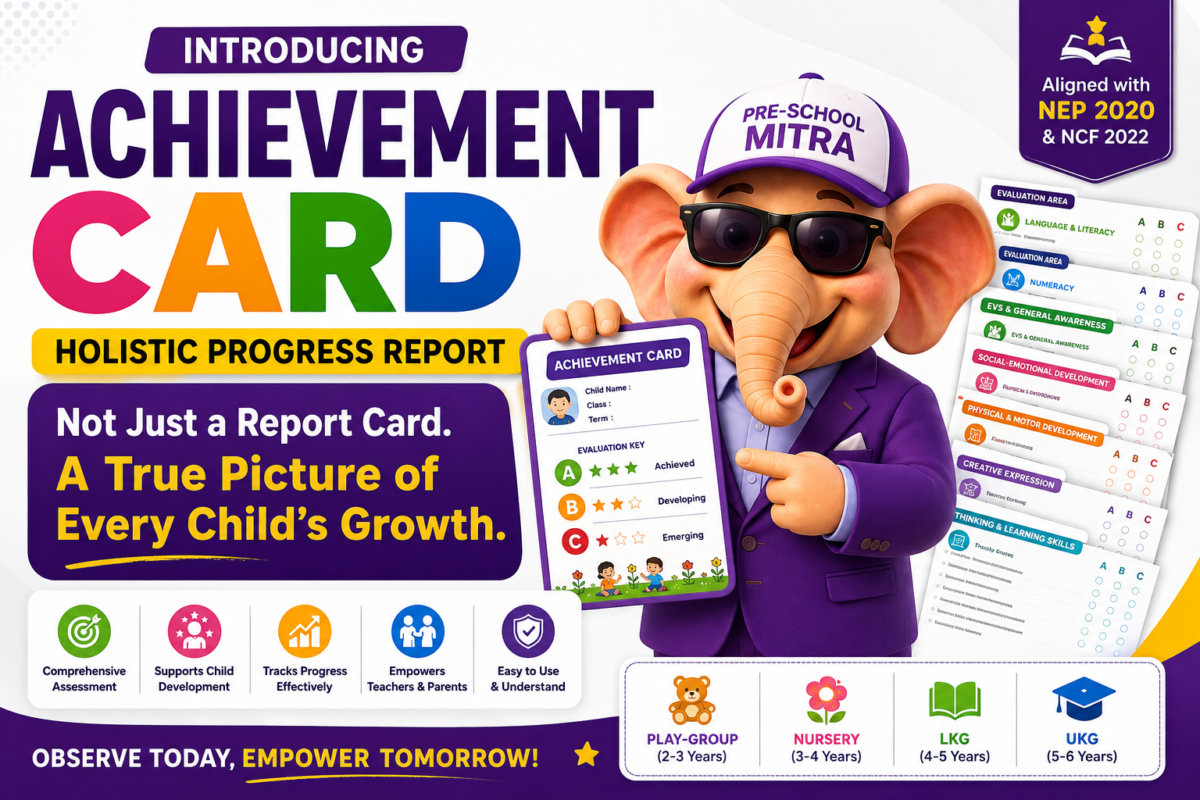
This is the thinking behind the Achievement Card by Preschool Mitra.
What is an Achievement Card?
The Achievement Card is a holistic developmental progress report designed specifically for preschool and foundational-stage children.
Instead of looking at a child only through marks, scores or subject grades, it documents age-appropriate developmental milestones and progress.
The Achievement Card is designed for four levels:
🧸 Play-Group — 2–3 Years
🌼 Nursery — 3–4 Years
📚 LKG — 4–5 Years
🎓 UKG — 5–6 Years
The important point is that the same assessment parameters are not applied to every age group.
A Play-Group child and a UKG child are at very different developmental stages. Therefore, the milestones, expectations and skills assessed need to progress with the child’s age.
From Report Card to Achievement Card
A conventional report card often focuses on questions such as:
- How many marks did the child score?
- What grade did the child receive?
- Did the child complete the academic work?
- How does the child compare with expectations?
These questions may have their place in formal schooling.
But preschool assessment needs a broader perspective.
The Achievement Card asks:
What can the child do?
What skills are developing?
What has the child achieved during the term?
Where does the child need additional support?
How has the child progressed over time?
This represents a shift:
Marks → Milestones
Grades → Growth
Testing → Observation
Comparison → Individual Progress
Report Card → Achievement Card
Why Preschool Assessment Needs a Different Approach
Between the ages of 2 and 6, children develop at different rates.
A preschool classroom may have children of the same chronological age who demonstrate very different levels of language, motor coordination, confidence, social interaction and independence.
That does not automatically mean one child is “better” than another.
Development is progressive.
A child who is currently learning to hold a crayon correctly is achieving something important.
A child who has started speaking in complete sentences is achieving something important.
A child who has learned to share and take turns is achieving something important.
A child who can independently pack away their toys is achieving something important.
Every little step matters.
The Achievement Card is designed to make these achievements visible.
What Does the Achievement Card Assess?
The Achievement Card takes a holistic view of development.
Depending on the child’s age and class, assessment covers areas such as:
1. Language & Literacy
Language development is much more than knowing the alphabet.
Age-appropriate milestones can include:
- Listening and understanding
- Following instructions
- Speaking and communication
- Vocabulary development
- Picture talk
- Story comprehension
- Rhymes and songs
- Oral language
- Alphabet awareness
- Phonics
- Letter recognition
- Letter-sound association
- Pre-writing
- Tracing
- Emergent writing
- Reading readiness
- Early reading
- Meaningful writing
The expectations gradually increase from Play-Group to UKG.
For example, a Play-Group child may be developing oral language, picture recognition, rhymes, scribbling and pre-writing readiness, while a UKG child may be progressing towards phonics, simple reading and meaningful writing.
2. Early Numeracy
Preschool mathematics should not simply mean memorising numbers.
The Achievement Card looks at the development of number sense and mathematical thinking.
Depending on the class, this can include:
- Oral counting
- Number recognition
- Quantity awareness
- One-to-one correspondence
- Matching numbers and quantities
- More and less
- Same and different
- Number sequencing
- Before, after and between
- Missing numbers
- Number writing
- Number names
- Shapes
- Colours
- Sorting and classification
- Patterns
- Measurement concepts
- Spatial concepts
- Simple addition and subtraction
For example, the curriculum progression may move from basic number awareness in Play-Group, to stronger number recognition and quantity understanding in Nursery, to 1–50 and number names 1–10 in LKG, and progressively stronger number concepts and early operations in UKG.
The goal is not merely:
“Can the child write the number?”
It is also:
“Does the child understand what the number represents?”
3. General Awareness & EVS
This is an especially important component of the Achievement Card.
Children are naturally curious about the world around them.
Their learning may include:
Myself
- Name
- Age
- Body parts
- Personal identity
My Family
- Family members
- Relationships
- Family routines
My School
- Classroom
- School environment
- School routines
My Neighbourhood
- Places around us
- Familiar surroundings
Animals & Birds
- Common animals
- Domestic and wild animals
- Birds and insects
Plants & Nature
- Plants
- Parts of plants
- Basic needs
- Caring for nature
Food
- Fruits and vegetables
- Healthy food
- Eating habits
Transport
- Land, water and air transport
- Basic safety awareness
People Who Help Us
- Doctors
- Teachers
- Police officers
- Firefighters
- Other community helpers
Seasons & Weather
- Seasons
- Weather changes
- Everyday observations
Colours & Shapes
- Recognition
- Classification
- Everyday application
The important difference is that the Achievement Card should not simply ask whether a child can memorise an EVS answer.
It should observe whether the child can:
recognise → understand → describe → connect → apply
according to their age.
4. Personal & Social Development
A child’s ability to interact with others is an important part of school readiness.
The Achievement Card therefore observes areas such as:
- Sharing
- Taking turns
- Cooperation
- Participating in group activities
- Following classroom routines
- Respecting others
- Caring for school materials
- Working with peers
- Following instructions
- Taking responsibility
- Showing empathy
- Developing independence
- Managing simple conflicts
These are not “extra” skills.
They are fundamental to a child’s ability to participate successfully in a learning environment.
5. Emotional Intelligence & Self-Care
Early childhood is also when children gradually learn to understand and manage their emotions.
Age-appropriate milestones may include:
- Recognising emotions
- Expressing feelings
- Communicating needs
- Seeking help appropriately
- Managing frustration
- Developing confidence
- Settling into school routines
- Following hygiene routines
- Handwashing
- Eating independently
- Toilet independence
- Managing personal belongings
- Understanding basic safety
Again, the expectations progress with age.
A Play-Group child may begin to recognise and express basic emotions, while a UKG child may be expected to demonstrate greater self-regulation and independence.
6. Physical & Motor Development
Children learn through movement.
The Achievement Card therefore includes both gross motor and fine motor development.
Gross Motor Skills
Depending on age:
- Walking
- Running
- Jumping
- Balancing
- Hopping
- Throwing
- Catching
- Climbing
- Movement coordination
- Outdoor games
Fine Motor Skills
- Scribbling
- Colouring
- Pencil/crayon control
- Tracing
- Tearing and pasting
- Finger painting
- Play dough
- Threading
- Cutting
- Puzzles
- Manipulating classroom materials
- Writing control
This is particularly important because pre-writing development begins long before formal handwriting.
7. Creative & Expressive Development
Children communicate in many ways beyond spoken and written language.
The Achievement Card therefore recognises:
- Drawing
- Colouring
- Painting
- Finger painting
- Printing
- Tearing and pasting
- Collage
- Clay/play dough
- Music
- Rhymes
- Dance
- Movement
- Drama
- Pretend play
- Creative expression
The objective is not to determine whether a child’s drawing is “perfect.”
It is to observe participation, imagination, expression, exploration and developing control.
8. Thinking & Learning Skills
As children progress towards UKG, their ability to think, observe and solve problems becomes increasingly important.
Age-appropriate milestones can include:
- Observation
- Curiosity
- Asking questions
- Identifying similarities and differences
- Sorting
- Classification
- Sequencing
- Pattern recognition
- Prediction
- Problem-solving
- Persistence
- Trying different approaches
- Explaining simple ideas
This moves assessment beyond “What does the child remember?”
towards:
“How does the child think?”
Assessment Is Age-Appropriate
One of the most important features of the Achievement Card is its developmental progression.
The four levels are not expected to demonstrate the same skills.
Play-Group — Explore & Experience
The focus is on:
- Oral language
- Sensory exploration
- Scribbling
- Basic concepts
- Colours and shapes
- Early counting
- Social adjustment
- Motor development
- Self-care beginnings
Nursery — Recognise & Participate
Children progressively develop:
- Vocabulary
- Letter awareness
- Pre-writing
- Counting
- Basic concepts
- Thematic awareness
- Social participation
- Emotional expression
- Greater independence
LKG — Understand & Apply
Children move towards:
- Phonics
- Letter recognition
- Early reading readiness
- Writing
- Numbers 1–50
- Number names 1–10
- Patterns
- Classification
- Early mathematical thinking
- Broader EVS understanding
- Greater social and personal independence
UKG — Communicate, Apply & Become Independent
Children progressively demonstrate:
- Stronger language and literacy
- Phonics and early reading
- Meaningful writing
- Stronger numeracy
- Early operations
- Broader EVS concepts
- Thinking and problem-solving
- Self-regulation
- Independence
- Grade 1 readiness
This creates a continuous developmental pathway from Play-Group to UKG.
The A–B–C Evaluation Key
The Achievement Card does not use A, B and C as conventional academic grades.
Instead, they represent developmental progress:
🟢 A — Achieved / Confidently Demonstrates
The child demonstrates the skill independently and confidently.
🟠 B — Developing / Demonstrates with Support
The child is developing the skill and may require guidance or occasional support.
🔴 C — Emerging / Beginning to Demonstrate
The child is beginning to demonstrate the skill and requires continued opportunities, practice and support.
This distinction is important.
The objective is not to label a child as an A, B or C child.
The objective is to help teachers understand where the child is on a particular developmental milestone.
How Does the Achievement Card Benefit Teachers?
For teachers, assessment can sometimes become a time-consuming exercise of collecting marks, maintaining records and preparing report cards.
A structured Achievement Card provides a clearer framework.
It helps teachers:
✔ Observe children more systematically
✔ Track developmental milestones
✔ Identify strengths
✔ Identify areas requiring additional support
✔ Plan appropriate learning experiences
✔ Have meaningful conversations with parents
✔ Document progress across terms
✔ Maintain continuity from one class to the next
Most importantly, it encourages teachers to become observers of learning, not just recorders of marks.
How Does It Benefit Parents?
Parents naturally want to know:
“How is my child doing?”
A percentage or grade doesn’t always answer that question.
The Achievement Card gives parents a broader picture.
They can understand:
- What their child has achieved
- Which skills are developing
- Where the child is confident
- Where the child needs support
- How the child has progressed during the year
It can also make Parent–Teacher Meetings more meaningful.
Instead of:
“Your child got a B in Maths.”
the conversation can become:
“Your child recognises numbers well, but is still developing one-to-one counting. We can support this through everyday counting activities.”
That is a much more useful conversation.
How Does It Benefit Schools & Preschools?
For schools and preschools, the Achievement Card is more than a document.
It can become part of the school’s academic identity.
1. A structured assessment system
Schools get a consistent framework for tracking development across Play-Group, Nursery, LKG and UKG.
2. Stronger parent communication
Parents receive a more meaningful picture of their child’s progress.
3. Better academic documentation
Teachers can maintain structured developmental records rather than relying only on informal observations.
4. A stronger academic offering
A school that demonstrates a thoughtful approach to early childhood assessment can differentiate itself from schools that simply issue conventional report cards.
5. Greater alignment between curriculum and assessment
The Achievement Card can be mapped to the school’s curriculum and age-appropriate learning milestones.
6. Better identification of support needs
Teachers can identify areas where children may need additional practice, reinforcement or individual support.
7. Consistency across classes
The same philosophy can continue:
Play-Group → Nursery → LKG → UKG
while the milestones become progressively more advanced.
Why This Is Not Just Another Report Card
The Achievement Card is not simply a report card with a different name.
The difference is in the philosophy behind the assessment.
A conventional report card often focuses on:
Result → Grade → Performance
The Achievement Card focuses on:
Observation → Milestone → Progress → Support
That is a fundamental difference.
A report card records performance.
An Achievement Card records progress.
A Better Question to Ask
Instead of asking:
“How many marks did the child get?”
we should also be asking:
“What has the child learned?”
“What can the child do independently?”
“What skills are emerging?”
“Where does the child need support?”
“How has the child progressed?”
These questions provide a much more meaningful picture of early childhood development.
Designed for the Foundational Years
The Achievement Card is designed around the understanding that the early years are foundational to a child’s later learning.
The approach is compatible with the broader direction of NEP 2020 and the National Curriculum Framework for the Foundational Stage, which emphasise holistic development, play-based and activity-based learning, foundational literacy and numeracy, communication, socio-emotional development, physical development, creativity and learning through meaningful experiences.
The important principle is not to bring a formal primary-school examination system into preschool.
Instead:
Assessment should grow with the child.
From Play-Group to UKG — A Journey of Growth
Think of the four years as a journey.
🧸 Play-Group
I explore.
🌼 Nursery
I recognise and participate.
📚 LKG
I understand and apply.
🎓 UKG
I communicate, think, apply and become independent.
The Achievement Card captures this journey.
For Schools Looking to Upgrade Their Assessment System
If your preschool or school is still using a conventional marks-based report card for the early years, it may be time to rethink what your assessment system is communicating to parents.
Your report card is not just a document.
It communicates your school’s educational philosophy.
If your curriculum believes in:
- Play-based learning
- Holistic development
- Age-appropriate learning
- Individual progress
- Experiential learning
- Social-emotional development
- Creativity
- Independence
- Foundational learning
then your assessment system should reflect the same philosophy.
That is the purpose of the Achievement Card by Preschool Mitra.
Achievement Card by Preschool Mitra
Not Just a Report Card.
A Record of Growth, Development & Achievement.
Designed for:
Play-Group | Nursery | LKG | UKG
With age-appropriate developmental milestones across:
Language • Literacy • Numeracy • EVS • Social-Emotional Development • Physical Development • Creativity • Thinking & Learning
Observe. Track. Nurture. Grow.
Because every child develops at their own pace.
And every achievement matters.
Interested in introducing the Achievement Card in your Preschool or School?
Connect with Team Preschool Mitra to explore how it can be integrated with your existing academic and assessment system.