


Holistic Assessment: Redefining Success in Preschools
In an era where early childhood education is increasingly recognized as the cornerstone of lifelong learning, holistic assessment emerges as a transformative tool for preschools. This approach evaluates the whole child—encompassing cognitive, social, emotional, physical, and creative dimensions—rather than isolating academic performance into rigid marks or grades. By aligning with frameworks like NEP 2020 and NCF 2022, holistic assessment promotes joyful, inclusive learning that nurtures curiosity and confidence, backed by research showing improved overall development and reduced stress in young learners.
Moving Beyond Marks and Grades
The early years are a time of wonder, where children master not only alphabets and numbers but also essential life skills like self-expression, empathy, friendship-building, and environmental exploration. Traditional assessments, however, often simplify this multifaceted growth into simplistic scores, stars, or percentages, which can create unnecessary pressure and overlook individual strengths. At Preschool Mitra, our holistic assessment system redefines success by celebrating the complete child—academic achievements alongside social-emotional resilience, physical coordination, and creative flair—ensuring the process remains engaging and low-stress.
What Makes Our Holistic Assessment Different?
Preschool Mitra’s system is uniquely designed to be comprehensive yet accessible, spanning seven core domains: language and numeracy for foundational skills, motor skills for physical development, creativity for imaginative expression, social-emotional growth for relationship-building, environmental awareness for curiosity about the world, and self-help abilities for independence. Unlike dense, jargon-heavy reports that confuse parents, we deliver straightforward, visual progress indicators—such as icons, photos, or simple charts—that highlight achievements in relatable terms, turning parent-teacher meetings into collaborative celebrations. Conducted twice per term to match the school’s natural rhythm, assessments are fully integrated with thematic activities, ensuring authenticity and alignment with NEP 2020’s emphasis on child-centric, play-based evaluation.
How It Works Across Preschool Classes
Our assessments are age-tailored, evolving with developmental milestones to provide precise, actionable insights at every stage. For Play-Group (2–3 years), the focus is on building comfort through exploration, oral recognition of letters and numbers, scribbling, and rhymes; teachers observe emotional expression, basic motor readiness like pencil grip, and independent play to gauge foundational security and curiosity. In Nursery (3–4 years), emphasis shifts to stroke mastery, capital letters, numbers 1–20, Hindi swars, and role-play; evaluations track writing readiness, clear speech during interactions, social participation, and emerging confidence in group settings.
LKG (4–5 years) builds on this with capital and small letters, numbers 1–50, full Hindi varnmala, rhymes, stories, picture talks, and crafts; assessments monitor literacy and numeracy progress, creative output, oral expression, and emotional poise, using portfolios of artwork and notes from discussions. For UKG (5–6 years), the spotlight is on numbers 1–100, addition/subtraction, Hindi matras, CVC words, sentence formation, and comprehension; evaluations assess Grade 1 readiness through reading fluency, number sense, independence in tasks, and leadership in peer activities. A key innovation is our ‘1 Day, 1 Book, 1 Concept’ model, which concentrates daily learning on a single focused idea, enabling sharper, more targeted assessments that reduce cognitive overload and improve retention across domains.
Implementing Holistic Assessment in Your Preschool
Transitioning to holistic assessment doesn’t require overhauling your entire setup—it’s about intentional integration that enhances existing practices. Start by defining your vision: align goals with NEP 2020’s holistic principles, such as play-based learning and competency tracking, and involve your team in collaborative planning sessions to ensure buy-in. Evaluate your current curriculum through a quick audit: identify gaps in domains like social-emotional observation and add flexible activities, such as themed play stations, to embed assessments naturally.
Next, redesign your environment and schedule: create child-centered spaces with open-ended materials (e.g., blocks for motor skills, art corners for creativity) and flexible routines that blend structured themes with free exploration, allocating time for outdoor activities to assess physical and environmental awareness. Train teachers via workshops on observational tools, emphasizing informal methods like play-based notes or portfolios over formal tests. Establish family partnerships by sharing simple home extension activities, such as “rhyme recaps,” and use digital templates for consistent reporting. Finally, build a reflection system: hold monthly check-ins to review data, adjust plans, and celebrate progress, ensuring sustainability through ongoing feedback loops. This phased approach—starting small with one class—minimizes disruption while maximizing impact.
LKG (4–5 years) builds on this with capital and small letters, numbers 1–50, full Hindi varnmala, rhymes, stories, picture talks, and crafts; assessments monitor literacy and numeracy progress, creative output, oral expression, and emotional poise, using portfolios of artwork and notes from discussions. For UKG (5–6 years), the spotlight is on numbers 1–100, addition/subtraction, Hindi matras, CVC words, sentence formation, and comprehension; evaluations assess Grade 1 readiness through reading fluency, number sense, independence in tasks, and leadership in peer activities. A key innovation is our ‘1 Day, 1 Book, 1 Concept’ model, which concentrates daily learning on a single focused idea, enabling sharper, more targeted assessments that reduce cognitive overload and improve retention across domains.
Practical Tips for Teachers on Holistic Assessment
Teachers are the heart of this system, and our ready-to-use formats in the Teacher’s Manual make it straightforward. Observe during natural play: note a child’s sharing during group rhymes (social-emotional) or block-building (motor and creativity) without interrupting flow, using quick checklists or photo journals for evidence. Integrate assessments into themes: for an “Animals as Our Friends” unit, evaluate language through story retells and environmental awareness via simple discussions on habitats.
Encourage child-led input: prompt reflections like “What did you discover today?” to capture emotional growth, and track self-help by observing routines such as tidying up. Balance domains weekly: dedicate time to each, like fine motor crafts on Mondays, to avoid silos. Share positives first in reports: frame growth areas as “next adventures,” suggesting home tips like finger-painting for dexterity. Use our Weekly Planner for prompts, ensuring assessments feel like joyful extensions of learning rather than chores—tips that reduce burnout and boost teaching efficacy.
Why Preschools Choose Our Holistic Assessment System
Educators value the teacher-friendly tools that align effortlessly with daily plans, cutting preparation time while providing clear rubrics for observations across domains. Parents rave about the approachable reports that emphasize strengths—like a child’s budding leadership—over deficits, leading to stronger partnerships and higher retention rates. Seamlessly woven into our thematic curriculum, it maintains consistency without extra effort, and custom branding elevates your preschool’s professional image, helping independent schools stand out without franchise costs.
A Complete Ecosystem for Early Childhood Success
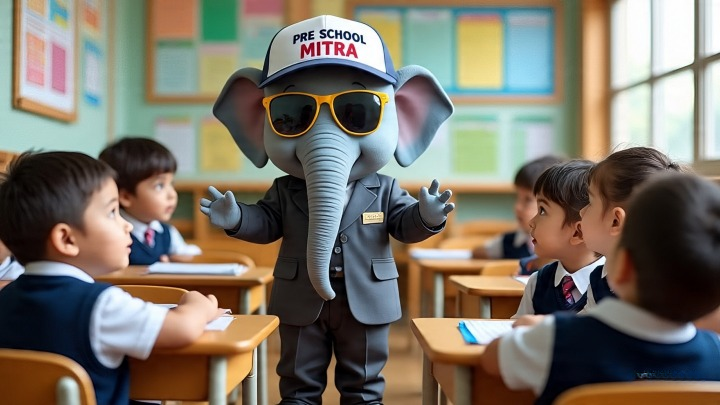
Preschool Mitra’s holistic assessment thrives within a supportive ecosystem tailored for Play-Group to UKG. Our thematic curriculum revolves around engaging central themes—Play & Exploration, Me as an Adult, Animals as Our Friends, Superheroes—delivered via 80–100 page books featuring structured lessons (introduction, comprehension, revision), hands-on crafts, rhymes, and stories that naturally feed into assessments. Gopu the Baby Elephant, our endearing mascot, appears throughout to guide and delight, making abstract concepts relatable.
Enhance execution with Teacher’s Manuals and Planners offering step-by-step activity guides and domain-specific tips, plus the ‘1 Day, 1 Book, 1 Concept’ model that keeps bags light and focus sharp. Full customization—from books to reports—with your school’s branding empowers solopreneurs to launch affordably, integrating play-based, NEP-compliant elements that support better holistic outcomes like enhanced creativity and social skills.
Our Vision for Preschool Education
We view preschools as vibrant foundations for lifelong curiosity, where assessments illuminate a child’s emerging identity—curious, confident, creative, and compassionate—rather than confining them to scores. By prioritizing holistic growth, we empower teachers, reassure parents, and equip children with resilience for future challenges, transforming education into a collaborative journey of discovery. This vision cultivates well-rounded individuals through interconnected, joyful learning experiences.
Ready to redefine success and implement holistic assessment in your preschool? Partner with Preschool Mitra for our complete, NEP-aligned system, including custom-branded curriculum, teacher tools, and implementation support. Contact us at www.preschoolmitra.in for a free PDF preview or to explore low-budget customization options that make premium education accessible. Let’s nurture the whole child together.
Enhance execution with Teacher’s Manuals and Planners offering step-by-step activity guides and domain-specific tips, plus the ‘1 Day, 1 Book, 1 Concept’ model that keeps bags light and focus sharp. Full customization—from books to reports—with your school’s branding empowers solopreneurs to launch affordably, integrating play-based, NEP-compliant elements that support better holistic outcomes like enhanced creativity and social skills.